

Though hellacious turmoil caused from the nightmarish strike of ’94 led to an abbreviated regular season in 1995, Major League Baseball was able to head into the 1996 season with more momentum than the financial numbers revealed. In the first year of the revised playoff structure, the format that was supposed to debut in 1994, the baseball world was fortunate to watch the two best teams, Atlanta and Cleveland, oust their league-mates en route to reaching the championship round.
Aside from the fact that the Braves and Indians finished with the best records in baseball, the matchup came with its fair share of fantasy-like storylines. Cleveland, who had won 100 of the 144 total games, ended their 41-year playoff drought and were looking to win their first championship since 1948. They were carried by their offense, who, despite playing in a shortened season, still managed to put up historical numbers. Cleveland’s three main stars, Manny Ramirez, Jim Thome, and Albert Belle, all hit over .300 with at least 25 home runs and an on-base percentage north of .400. At that time, the only other trio of teammates who had done that in MLB history was Lou Gehrig, Joe DiMaggio, and Bill Dickey, who matched those statistics in 1937 while suited up for the New York Yankees.
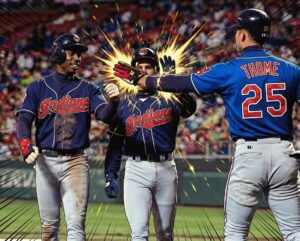
Aside from Cleveland’s Big Three, their loaded lineup also consisted of Hall of Famer Eddie Murray, who hit 21 home runs, Kenny Lofton, who led the league in triples and steals, and Omar Vizquel, who won his third-straight Gold Glove Award at shortstop. As a collective unit, the Indians finished 1st in the American League in runs, hits, home runs, stolen bases, batting average, on-base percentage, slugging percentage, OPS+, and total bases. They were one of the most stacked lineups in the game’s history and should have had the MVP winner, had the award been voted on in a proper manner.
In 1995, Albert Belle had one of the most impressive offensive seasons ever. Even with the abbreviated season, Belle, in 143 games, became the first player in MLB history to finish a year with at least 50 doubles and 50 home runs. He led the league in runs (121), doubles (52), home runs (50), RBI (126), slugging percentage (.690), and total bases (377). The catalyst for their potent offense, Belle was far and away the best player in the American League yet ended up finishing runner-up to Mo Vaughn of the Boston Red Sox.
The assumed reason as to why Belle was snubbed had everything to do with his relationship with the reporters, as he had earned a reputation for being disobedient and, at times, crude to the media. While he was a highlight reel in between the foul lines, Belle, on numerous occasions, had a few ‘lowlight’ moments that the voters didn’t forget about when it was time to cast their ballots. On the road for a series in Seattle, a fan in a hotel lobby asked Belle if he had any extra tickets to the game, to which Belle allegedly replied, “No, and even if I did, I wouldn’t give them to you; you’re too funny looking.” When a bunch of kids in Milwaukee attempted to get his autograph, Belle allegedly shouted, “No! And stop yelling my name!” Another one of his fans in Detroit tried to compliment his way into Belle’s good graces for a signature, telling the ballplayer, “I’m your biggest fan.” To which Belle responded with, “I don’t give a [expletive] about that.” When a reporter in New York got too close to Belle while the ballplayer was at his locker, the star, in a sarcastic manner, asked the journalist, “What do you think this is, a barbeque?”
As many know, members of the BBWAA are the ones that vote on the season awards, so fracturing your connection with these writers is not an ideal move, to say the least. Since the inauguration of the award, the nominators have pretty much always played it by the book, and published as one of the guidelines to take into consideration when selecting a player for the prestigious honor is “General character, disposition, loyalty, and effort.” So on one hand, it’s hard to blame the electors, but on the other, it could be perceived as a slap in the face to the game and its superstars when a player does something of great significance that no other man has done in the history of the sport. Even Vaughn had to tip his cap to Belle’s unrivaled season. “I know that he had some great numbers,” said Vaughn at a news conference in Boston after edging out Belle in the race. “If it’s numbers, he probably would win.”

Belle’s extraordinary output in the heart of a remarkable lineup brought immense joy to the Cleveland fanbase, a bunch that had been suffering for far too long. Along with winning more games than everyone else in the sport, Cleveland finished 2nd in the American League in attendance, and the moment it was official that they would be competing in the postseason for the first time since 1954, the fans made sure to publicize their support. According to the team’s director of merchandising and licensing, Jane Chruchmack, after the team clinched a berth in the playoffs on September 9, the team sold 67,000 items over the next week. An astounding mark that included merchandise sales at the team’s stadium and at a pair of shops right outside of Jacobs Field. By Chruchmack’s account, 70 percent of the Indians retail sales for the 1995 season came in the first 10 days after the team secured a spot in the playoffs. Translation: Winning sells, no matter the industry or current trend.
While there was no question that Cleveland’s offense in 1995 was potent, reigning supreme above all, Atlanta’s hitters were, in some ways, just as good. Though no one on the club reached the 30-home run mark, the Braves were the only team in baseball who had at least seven players hit 12 or more home runs. They were a complete offense, led by a pair of veterans, Fred McGriff and David Justice, and a duo of young stars, Chipper Jones and Ryan Klesko. On top of their wide range of talent at the plate, the Braves had something that the Indians lacked, which was dominant pitching. As mentioned prior, Atlanta, in the midst of a legendary run, having gone to the World Series in 1991 and 1992, was carried by their premier pitching staff. Akin to how Cleveland had its Big Three on offense, Atlanta had their own big three: Greg Maddux, John Smoltz, and Tom Glavine, who were all amongst the best in the game. That year, Smoltz led the terrific trio with 193 strikeouts, Glavine finished third in the NL Cy Young voting, and Maddux did Maddux things. Had Cal Ripken Jr.’s streak not existed, Greg Maddux would have won the AP Male Athlete of the Year for 1995, as the Braves ace finished runner-up in voting, ahead of Houston Rockets star Hakeem Olajuwon and NASCAR standout Jeff Gordon.
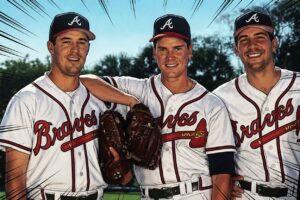
Maddux got the ball for Game 1 of the Fall Classic and, as anticipated, did not disappoint. He pitched all nine innings in the Braves’ 3-2 series-opening win. Both runs that Cleveland plated were unearned, as they were set up by errors. Overall, the league’s best offense hit just four balls out of the infield against the mighty Maddux. In attempting to time up their swings to perfection against Atlanta’s ace, Eddie Murray, Albert Belle, Paul Sorrento, Manny Ramirez, and Jim Thome all had their bats shattered on swings against him. “I’ve never seen so many bats broken,” said Indians assistant clubhouse manager Cy Buynack after the tilt.
As the series went on, Atlanta’s combination of solid hitting mixed with premier pitching proved to be too much for the offense-heavy Indians. Though the series went six, Atlanta stifled the Indians lineup throughout the string of games. In the regular season, Cleveland led all of baseball with 5.83 runs per game. Against Atlanta in the World Series, they scored just 3.16 runs per contest and were shut out in the series-clincher. As a unit, they hit a league-high .291 in the regular season, but when it mattered most, the Indians batted .179 in the six World Series games. Even Albert Belle, the best player in the league over the course of the season, struggled, hitting just .235. To make matters worse, after the Indians dropped the first two games of the series, Belle took out his frustration on the media. About two hours before the first pitch of Game 3, NBC-TV reporter Hannah Storm made her way into the Cleveland locker room to interview Kenny Lofton. Belle, who, at that point, was hitting .167 (1-for-6) in the World Series and .229 (8-for-35) in the playoffs, wanted Storm and the rest of the reporters out of their personal area. Storm, who was doing her job, as the interview with Lofton was a prearranged one with lights and cameras set up, refused to exit, which set Belle off. He went on a profanity-infused tirade for five straight minutes on all those in attendance. Due to the circumstances, the rant made national news. Though he did later apologize, had the bulk of ballots for the MVP voting not already been submitted prior to his moment of rage, there’s a great chance that Vaughn would have stolen even more votes from him.
Since it was such a compelling series, imbued with thrilling narratives like ‘best pitching vs best hitting’ and the ‘team of the decade who has yet to get over the hump vs team looking to pop champagne for the first time since 1948’, the 1995 World Series was a success in the eyes of Major League Baseball. According to Nielsen Media Research, in a year where the regular season numbers took a substantial hit, ratings for the 1995 World Series were up 13 percent over 1993. In a cross-sport comparison, the Fall Classic rating was 40 percent higher than the NBA Finals, a matchup where Houston swept Orlando. Though when lined up against the NFL, baseball didn’t fare too well. In January, Super Bowl XXIX, a clash between San Francisco and San Diego, received a 41.3 rating, which was 112 percent higher than the World Series. Yet, out of fairness to baseball, linking the diamond to the gridiron had been an unfair correlation for quite some time. After years in which baseball was king in this country, in 1972, courtesy of the annual Gallup poll, the NFL snatched the crown from MLB as the public’s favorite sport to watch. In every year since, the NFL has remained number one. With that said, the goal in 1995, after all that had transpired, was to stay afloat, and by outperforming the ratings from the previous World Series, the league did just that. “Given the way things have been going this year, this is obviously something we can build on,” said acting commissioner Bud Selig at the time of the ratings becoming public.